
The Story of the Bounty Mutineers
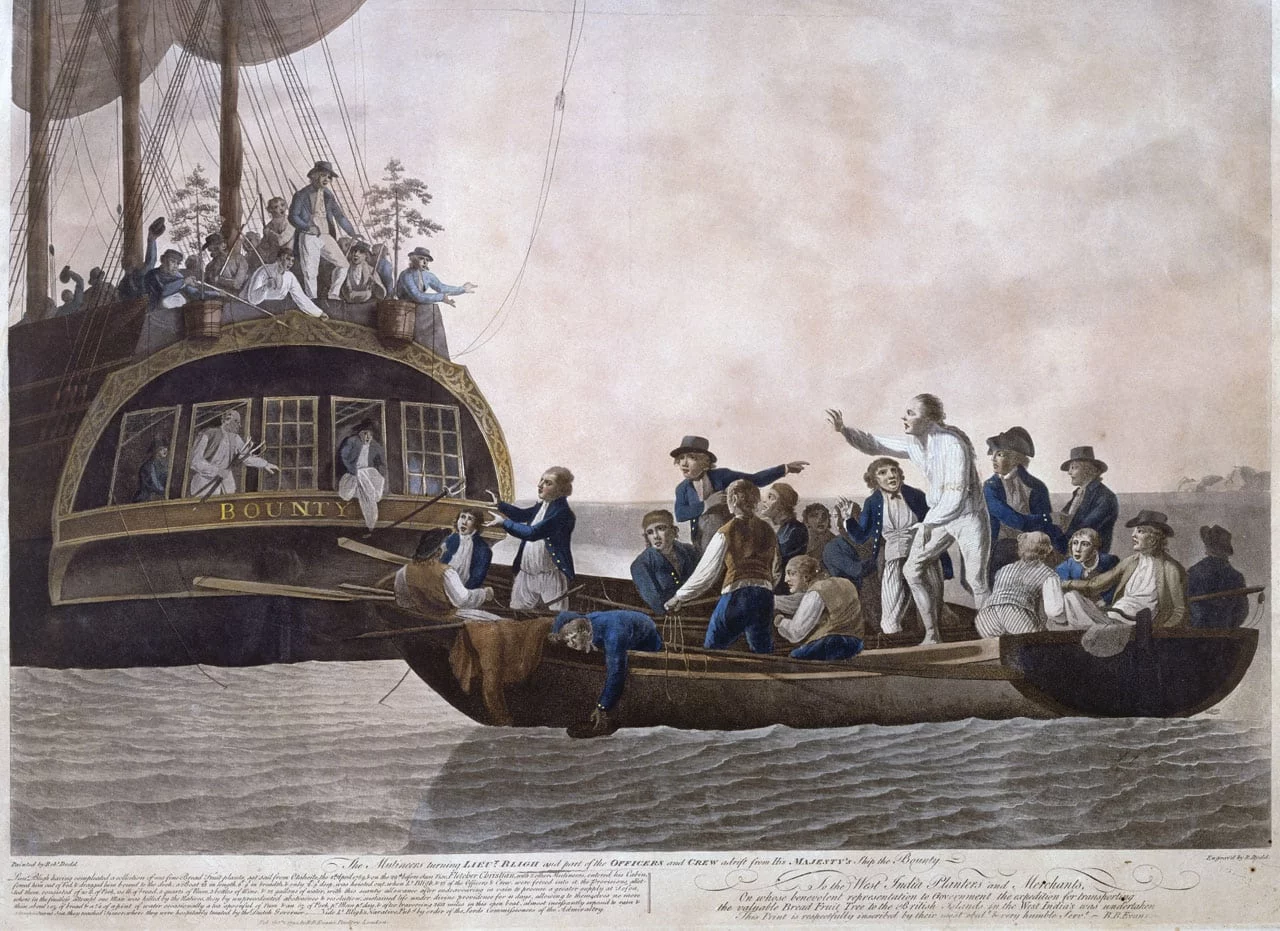
On April 28, 1789, the men aboard the H.M.S. Bounty, a British naval ship commanded by Captain William Bligh, organized a legendary mutiny. After spending several idyllic months on the island of Tahiti, these men wished to establish a colony in the South Pacific.
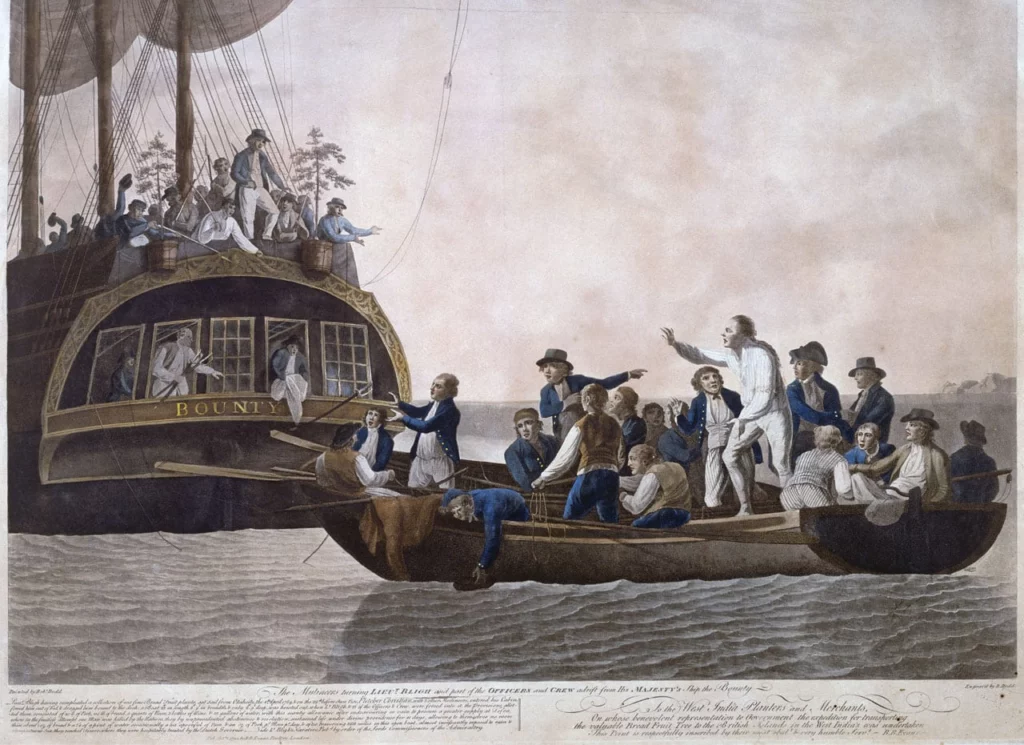
Fletcher Christian and the mutineers left adrift Captain William Bligh and 18 sailors who had remained loyal to him ; engraving by Robert Dodd (1790).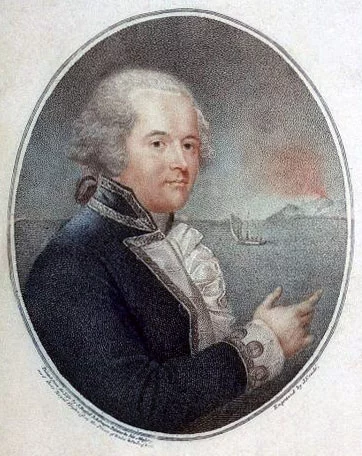
William Bligh, captain of the Bounty.
An epic journey
When the H.M.S. Bounty left England in November 1787, neither its captain nor its crew could have imagined that their peaceful voyage would end before a court-martial and would result in generations of colonists on Tahiti, a distant island in the South Pacific.
Sail toward the island of Tahiti
The Bounty was a frigate of the Royal Navy. Its mission was to collect breadfruit trees from Tahiti and then transport them to the British West Indies, where they would serve as food for slaves.
Veteran Captain William Bligh had been tasked with making a voyage to collect fruits and plans of the breadfruit tree (Uru in Tahitian), a variety of tropical fruit with a fig-like taste. The British Crown saw this as a nutritious and inexpensive ration for the slaves on the sugar cane plantations of the British Caribbean.
For this peaceful mission, aboard the ship were forty-six men, including two botanists, but no officers other than Bligh. The ship was sailing alone, without the protection of another Royal Navy vessel. Bligh had planned a peaceful voyage to Tahiti, an island that Captain James Cook had visited in 1769. The island was viewed by British sailors as a paradise rich in breadfruit.
After a journey of nearly a year and ten days under the storm, the ship arrived in Tahiti in October 1788 and stayed there for five months. The island was as paradisiacal as the crew had imagined. They fully enjoyed it. The sailors indulged in a pleasant life and many formed bonds with the locals. They also established connections with the island women, who exchanged sexual favors for certain objects, such as nails. During the day, the crew harvested breadfruit and tended to the plants. At night, they had fun. This paradisiacal life had the consequence of deteriorating relations between the crew, the officers, and Captain Bligh.
The Origin of the Mutiny
When the Bounty set sail on April 1st in 1789, the idea of a mutiny had already taken root in the minds of the crew. The sailors showed their hostility when Captain Bligh, trying to restore discipline, became increasingly harsh. Despite the initial friendship between Christian and Captain Bligh, their relationship grew tense over the course of the voyage. During the journey, the captain was 'critical, insulting, petty, and condescending. He made Fletcher Christian the scapegoat, punishing him in front of the entire crew. On April 27, he accused Christian of stealing the ship's supply of coconuts and punished the entire crew for this theft. Three weeks after leaving Tahiti, he incited a mutiny in which more than half the sailors participated.
Although the true cause of the mutiny is still debated by historians, it seems clear to them that for Christian, his captain's accusation was the final blow. On April 28, a group of rebels led by Christian armed themselves with the muskets found on the Bounty to disembark in Bligh's cabin and take him prisoner. Christian would have told Bligh,
Then came chaos. The ship's crew split into two factions: one loyal to Bligh, the other determined to desert. The twenty-three mutineers isolated the captain along with eighteen other men on a boat. They gave them a few rations and a sextant to help with navigation, after which they sent the boat out to sea. The Bounty was now in the hands of the rebels.
Christian and his crew, who included a few loyalists still faithful to Bligh, wished to establish a colony. They chose Tubuai, the island of Tonga, more than 600 km south of Tahiti. There, they encountered a hostile group of natives, whom they killed. They returned to Tahiti in search of workers and supplies. The rebels disguised their mutiny and lied about their mission because they were certain that the Tahitian chiefs, who maintained good relations with Britain, would have refused to help them upon learning what had happened. The British thus returned to Tubuai with thirty Tahitians. Hostilities with the islanders and divisions within the crew worsened day by day. Soon, the men abandoned the fight and settled on Tubuai.
When the mutineers returned to Tahiti, they discovered that their lie had been exposed. Thinking that a new mutiny was being prepared, Christian, desperate, lured a group of Tahitians aboard the Bounty for a feast, before capturing them and setting sail. Sixteen British sailors were left behind on Tahiti.
Meanwhile, Bligh and his loyalists continued their frantic journey on their own. First, they headed to another island in Tonga. They quickly left after a hostile encounter with the islanders, who stoned the ship's quartermaster. Rations were running low. The crew therefore decided to head toward a Dutch colony on Timor, more than 6,000 km away. After forty-seven days, they landed and revealed the mutiny to the Crown.
Several sailors perished on the return journey to England, but Bligh survived. « I have lost the Bounty, » he wrote to his wife just before his departure for the United Kingdom. « My conduct has been exemplary, and I have shown to all that, as devoted as I have been, I have defied all enemies who sought to harm me. »
The aftermath
Upon his arrival, Bligh was tried by court-martial for abandoning his ship and was acquitted. The H.M.S. Pandora set sail from England with the mission of capturing the mutineers. When the crew arrived in Tahiti in March 1791, they took fourteen mutineers prisoner, those who had been abandoned by Christian. The Pandora sank shortly afterward after running aground on the Great Barrier Reef. Four of the still-chained captives drowned.
In September 1792, the ten men returning to English soil were tried by a court-martial. Under English law, any man who remained on the ship was considered guilty of mutiny, whether or not he had actively participated. Four of the mutineers were acquitted, the other six were sentenced to death by hanging. Three of the six sentenced were ultimately pardoned. The remaining three, Thomas Burkett, John Millward, and Thomas Ellison, were hanged on October 29, 1794.
Meanwhile, the rest of the mutineers and their Tahitian prisoners had found refuge on the island of Pitcairn, lost in the South Pacific. This deserted and lush island was like a paradise. The mutineers quickly burned the Bounty and settled there.
However, the tensions that had spoiled their journey persisted on the island. The Tahitians who had been captured by the mutineers accused the British of having abused their women, treating them as sexual objects. Tevarua, a Tahitian woman, is said to have even taken her own life following the violence she had endured. In September 1793, the Tahitians killed four of the eight mutineers, including Christian. During the following decade, all the rebels died, except for John Adams.
The descendants of the mutineers settled on Pitcairn Island, abandoning it multiple times before returning in search of provisions and land to cultivate. They still live on the small island today, which is considered a British Overseas Territory inhabited by around fifty people. In 1957, Luis Marden, explorer for National Geographic, rediscovered the remains of the Bounty, or at least what was left of it, off the eastern coast of the island.
Today, the story of the Bounty remains in people's memories due to its prominent place in the colonial past of Great Britain, as well as for its dramatic nature. In 2017, historian Diana Preston shared her insights with National Geographic. Between diseases, the arrival of Christian missionaries, and the sexual exploitation of women, European explorers 'indeed destroyed everything that people had found exotic and appealing in Tahitian culture'.
HMS Bounty
His Majesty’s Armed Vessel (HMAV) Bounty or Her Majesty’s Ship (HMS) Bounty was originally a coal ship named Bethia, built in the Blaydes shipyard in Kingston, Yorkshire, in 1784; the ship was renamed after its purchase by the Royal Navy for the sum of 1,950 pounds. The vessel was a three-masted ship 28 meters long, 7.6 meters wide, and with a tonnage of 230 tons. Its armament consisted of four four-pound cannons on carriages and ten half-pounder swivel guns, not counting the muskets carried by the crew. Since it was registered with the Admiralty as a cutter — the lowest rank used by the Royal Navy — the Bounty was commanded by a lieutenant rather than a captain, and the captain was also the only officer on board. In addition, cutters did not carry the usual detachment of Royal Marines used by commanders to enforce obedience.
The Bounty was purchased to transport breadfruit trees from the Polynesian island of Tahiti in the South Pacific to the British colonies in the West Indies. The expedition was supported by the Royal Society and was organized by its president Joseph Banks in order to provide cheap food for slaves (Banks owned sugar cane plantations in Jamaica). For this mission, the Bounty was modified under Banks' supervision at the Deptford shipyard on the Thames. The large cabin, which usually served as the captain's quarters, was transformed into a greenhouse capable of holding more than a thousand potted plants. This reduction in space meant that the crew, the sailors, and the commander would have to endure great overcrowding during the long months of the voyage.
Why the Bounty Lodge?
Firstly because the HMS Bounty anchored in the bay located opposite the Bounty Lodge at PK5 in Arue, and secondly as a nod to the co-author of the book « Les révoltés du Bounty », James Norman Hall, who lived in the property adjacent to the Bounty Lodge.