
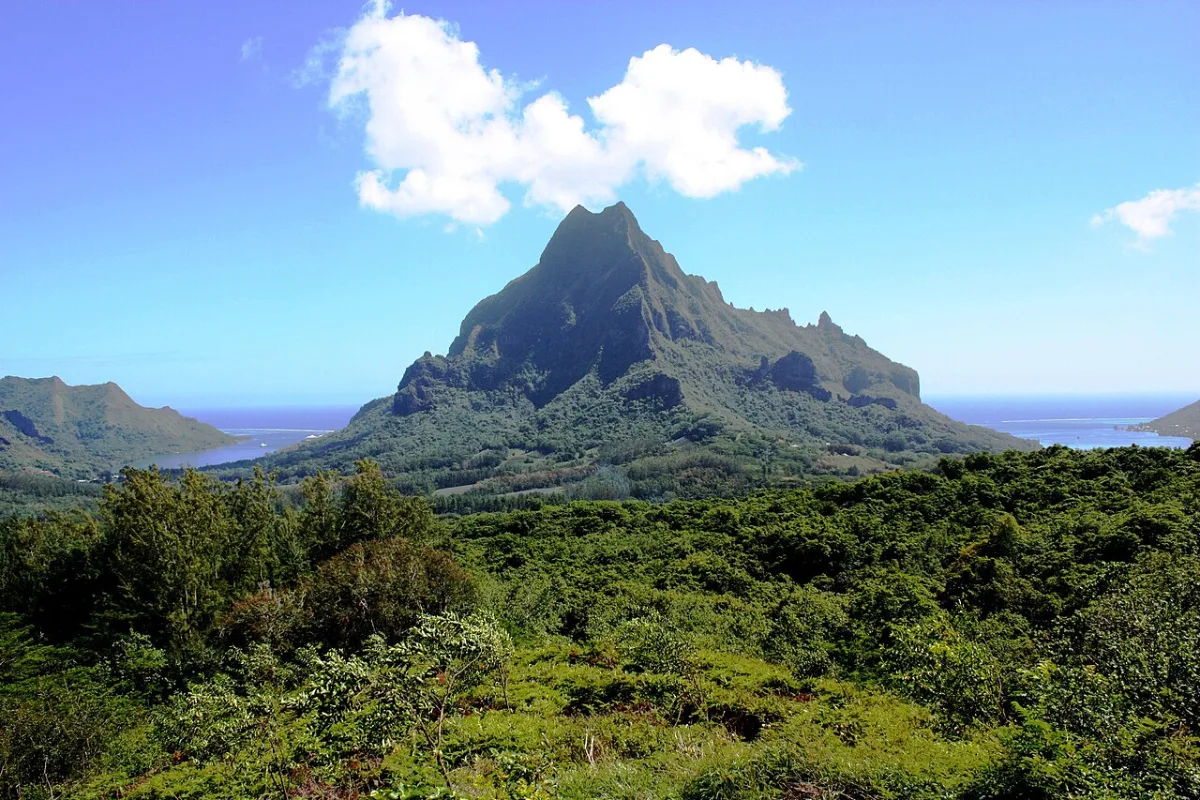
Moorea lies just across from Tahiti, about 17 km from Papeete. Volcanic peaks, deep bays, turquoise lagoon, and a valley rich in history: this sister island is perfect for both a day trip or a multi-night stay. Here's what to see and do in Moorea, with practical information from official sources.
In short — last updated October 23, 2026
- Access: ferry from the Papeete maritime station to the Vaiare dock (approximately 30 to 45 minutes); Tahiti Tourisme also mentions about 10 minutes by plane.
- Island tour: a coastal route of approximately 60 to 64 km, taking 2 to 3 hours with stops.
- Must-sees: Opunohu viewpoint (240 m), Opunohu valley marae, Cook and Opunohu bays, Temae beach, Tiahura lagoon.
- Whales: humpback whales frequent Polynesian waters from July to November, with regulated approach distances.
- Ideal for: hiking, snorkeling, Polynesian culture, day trips from Tahiti.
Getting to Moorea from Tahiti
The majority of visitors arrive in Moorea by sea. According to the Direction polynésienne des affaires maritimes (page updated in October 2026), several operators connect the Papeete maritime station to the Vaiare dock on the east coast of Moorea: Aremiti (ships Aremiti 5 and 6), Tauati Ferry (Tuatea group), Vaeara’i, and Terevau. The Routard estimates the crossing to take between 30 and 45 minutes; Tahiti Tourism says approximately 30 minutes with several departures daily.
Schedules and prices vary depending on the company, day, and season: check directly on the ferry operator's website before departure, especially on Sundays and during school holidays. If you arrive at Faa'a Airport with luggage, a pre-booked transfer to the marina avoids the need to look for a taxi upon arrival.
On site, a car or motorcycle remains the most flexible way to explore the island. To compare rental companies, you can use a car rental comparator, or read our article on car rental in Tahiti.
What to see in Moorea: the must-sees
The Opunohu viewpoint
This is the postcard image of Moorea. At 240 meters above sea level, in the heart of the island, the viewpoint overlooks the two large bays of the north, separated by Mount Rotui: Opunohu Bay on the left, Cook Bay on the right. Tahiti Tourisme notes that you can also see pineapple plantations located in the old crater. The site, open all year round, has a parking area and a picnic spot, and several marked trails lead from it, for walking or cycling.
The Opunohu Valley and its marae
Below the viewpoint, the Opunohu Valley is one of the major archaeological sites in French Polynesia. The Department of Culture and Heritage recalls that the team of archaeologist R.C. Green inventoried more than 500 structures there: family and community marae, house foundations, agricultural terraces, and three archery platforms. The visible structures were restored in 1969 under the direction of Dr. Y.H. Sinoto (Bishop Museum of Honolulu).
Three restored marae are worth a stop: Ahu-o-Mahine, named after a chief from the late 18th century; Afareaito, the 'house of warriors,' located near the archery platforms; and Titiroa (Tetiiroa), with its fifteen standing stones. Tahiti Tourisme estimates 30 to 45 minutes for visiting the marae, which is freely accessible, and recommends starting with the ecomuseum Fare Natura, at the entrance to the bay.
The Cook and Opunohu Bays
These two deep bays cut into the northern coast beneath Mount Rotui. Cook Bay (Paopao) is the starting point for many sea excursions, including dolphin and ray watching, according to Tahiti Tourisme. The road that runs along the two bays offers some of the most beautiful views on the island circuit.
The beaches: Temae and Tiahura
Temae beach is renowned for its white sand, turquoise water, and view of Tahiti. To the northwest, the Tiahura area provides access to the lagoon's motus, which can be reached by kayak or paddle. The Routard notes that you can spot stingrays in the calm lagoon near the beach of the Les Tipaniers hotel.
Things to do in Moorea
Snorkeling, diving, and lagoon excursions
The lagoon of Moorea is ideal for snorkeling right from the beach. For diving, Tahiti Tourisme highlights the Taotoi and Tiki passes, where you can encounter manta rays, reef sharks, and turtles. Boat excursions also allow you to get close to blacktip sharks, according to The Routard. Tahiti Tourisme provides approximate price ranges of around 50 to 80 € for a snorkeling or dolphin tour, and 80 to 150 € for a diving excursion: check the price with the provider when booking. To learn more, read our article on water sports and diving in French Polynesia.
To compare available excursions (lagoon tour, picnic on a motu, snorkeling), check out the activities in Moorea on Viator.
Whale watching (July to November)
Humpback whales come to mate and give birth in Polynesian waters from July to November. Since a decree published on April 25, 2024, regulations require a distance of 100 meters between the animal and authorized boats, and 15 meters for swimmers. Choose an approved operator and follow their instructions. Find all the details in our article on the humpback whale season in French Polynesia.
Hiking
Moorea is a hiker's island. The durations below are those indicated by Tahiti Tourisme; start early, bring water, and check the condition of the trails after heavy rain.
| Hiking | Estimated duration | Level |
|---|---|---|
| Opunohu Valley | about 1 hour | Easy |
| Pine Tree Pass | about 1 h 30 | Moderate |
| Col des Trois Cocotiers | approximately 2 h 30 | Moderate |
| Mount Rotui (899 m) | about 3 h | Difficult |
Culture and flavors
The Tiki Village offers a dance performance accompanied by a Polynesian dinner. The pineapple plantations on the island can be visited, with tastings of juices, jams, and liqueurs, according to Tahiti Tourisme. Add a stop at the beachside food stalls and you'll have a good glimpse of local life.
Itinerary: Moorea in one day from Tahiti
- Morning: first ferry from Papeete, pick up the vehicle at Vaiare, then head to Temae beach for the first swim.
- Late morning: drive along Cook Bay and Opunohu Bay, then climb to the viewpoint and visit the marae in the valley.
- Noon: lunch on the northwest side, near Tiahura.
- Afternoon: snorkeling or lagoon tour, then a tour of the southern and western coast to return to Vaiare.
- Late afternoon: ferry back to Papeete. Check the time of the last departure the day before.
With two or three nights on site, you'll add a sunrise hike, a whale-watching excursion during season, and a dinner-show. To choose your accommodation, compare the accommodations in Moorea on Booking.com and the hotels in Moorea on Trip.com, or browse our guide to accommodations in French Polynesia.
When to visit Moorea?
Moorea can be visited all year round. Tahiti Tourism indicates temperatures generally between 25 and 30 °C, and around 25 to 27 °C from May to October, the coolest period. This period partly coincides with the whale season (July to November). For other ideas by island, consult our guide to Tahiti and its islands and our page activities in French Polynesia. If you haven't yet booked your ticket, you can compare flights to Papeete.
FAQ: What to do in Moorea
How long does it take to visit Moorea?
A day is enough for a tour of the island (2 to 3 hours of driving with stops, according to Tahiti Tourisme), the viewpoint, and a swim. Plan for two to four nights to add hiking, lagoon excursions, and, in season, whale watching.
How to get from Tahiti to Moorea?
By ferry from the Papeete maritime station to Vaiare (approximately 30 to 45 minutes), with several companies: Aremiti, Tauati Ferry, Vaeara’i, and Terevau. Check their websites for daily schedules.
Should you rent a car in Moorea?
This is the most practical way to tour the island and climb to the viewpoint at your own pace. You can also book a tour with included transportation.
When to see whales in Moorea?
From July to November. Polynesian regulations require a distance of 100 meters for boats and 15 meters for swimmers.
Is visiting the Opunohu marae a paid activity?
No: Tahiti Tourism indicates it is freely accessible, for a visit lasting 30 to 45 minutes.
Sources
- Tahiti Tourisme, What to do in Moorea (consulted October 23, 2026)
- Tahiti Tourisme, Opunohu Viewpoint (consulted on October 23, 2026)
- Tahiti Tourisme, A day in the mystical Opunohu valley (consulted on October 23, 2026)
- Culture and Heritage Department, Restored archaeological sites in the Opunohu Valley (February 11, 2022)
- Direction polynésienne des affaires maritimes, Moorea Ferries (updated October 5, 2026)
- The Routard, Moorea (consulted on October 23, 2026)
- Les Nouvelles Calédoniennes / AFP, In French Polynesia, the growth of whale-watching tourism raises concerns (September 17, 2024)
- Photo: Daniel Julie, Mount Rotui and Opunohu and Cook Bay, CC BY 2.0, via Wikimedia Commons